Reach Truck vs. Counterbalance Forklift: A Complete Warehouse Equipment Selection Guide
Discover the key differences between reach trucks and counterbalance forklifts. Compare lifting capacity, aisle width, warehouse applications, operating efficiency, and costs to choose the right material handling equipment for your warehouse in Saudi Arabia.
Reach Truck vs. Counterbalance Forklift: A Complete Warehouse Equipment Selection Guide
Should your warehouse use a reach truck or a counterbalance forklift? Both machines lift and transport palletized goods, but their designs serve different workflows. A reach truck is primarily engineered for stacking and retrieving pallets from high racking in relatively narrow aisles. A counterbalance forklift is a versatile material-handling truck often used for loading, unloading, ground-level transport, and moving loads between work zones. Selecting between them takes more than comparing purchase prices or nominal lift capacities: you need to understand the warehouse layout, pallet dimensions, rack height, floor conditions, and the real work cycle.
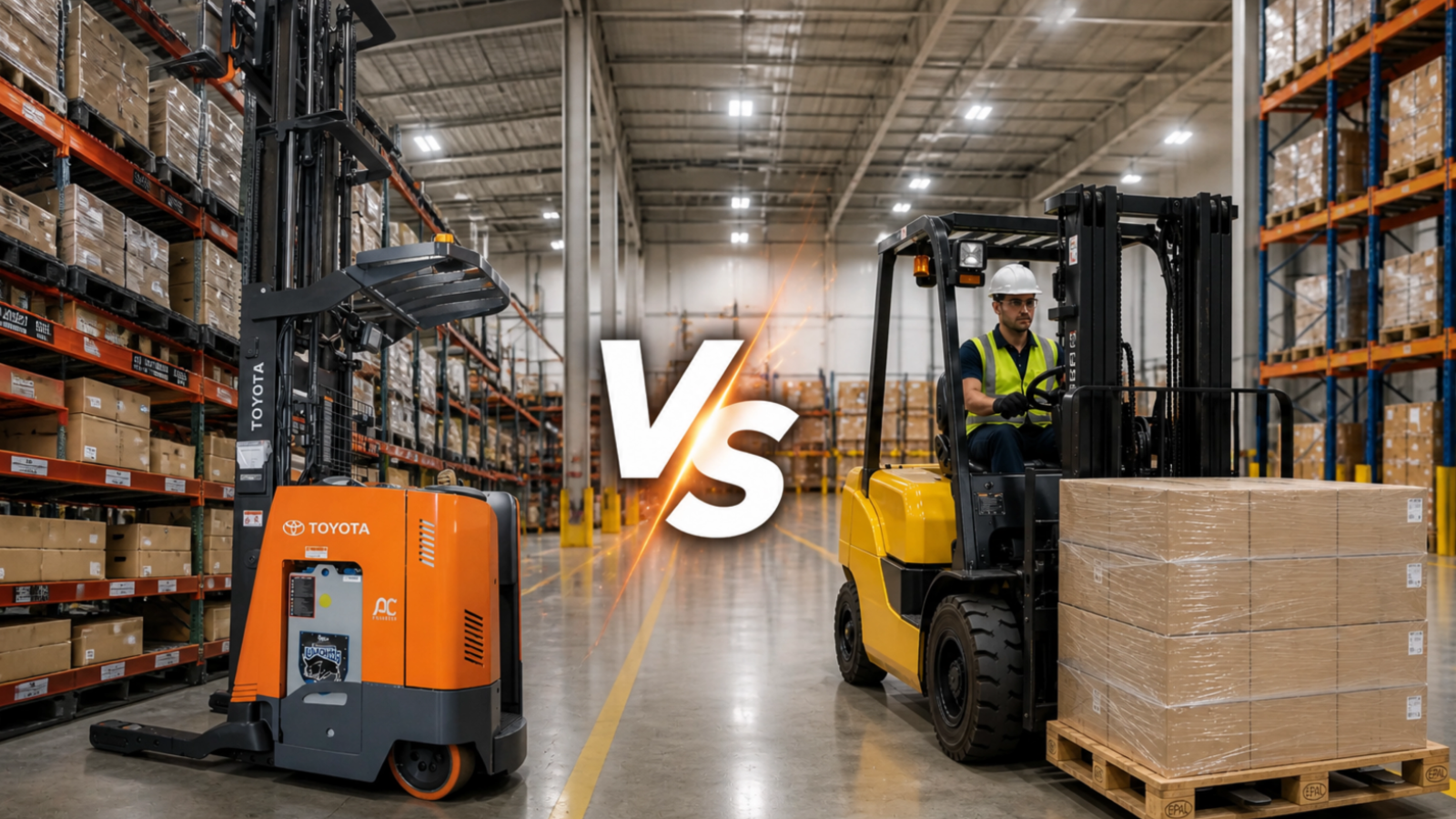
In brief: Choose a reach truck for suitably designed high-bay storage and narrow rack aisles. Consider a counterbalance forklift for general material handling, truck loading and unloading, and mixed operating areas. Some operations benefit from using both types as complementary machines.
1. What is a reach truck?
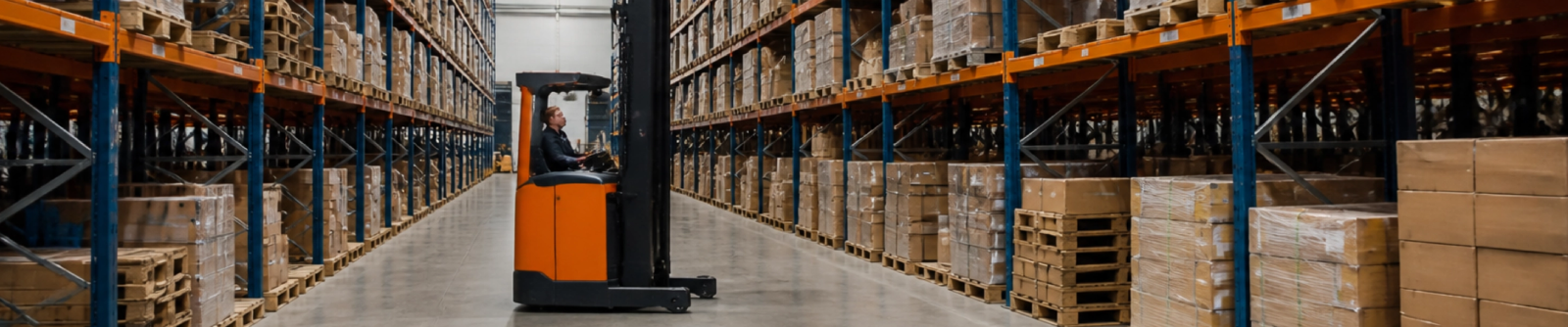
A reach truck is a specialized, usually battery-electric industrial truck built to handle pallet loads on tall warehouse racks. Its compact chassis typically includes forward support legs or outriggers. Depending on its design, either the mast moves forward on rails (a moving-mast reach truck) or a pantograph mechanism extends the fork carriage into the racking. The truck then brings the load back into a supported carrying position before traveling.
Because of this geometry and compact layout, reach trucks are commonly able to perform stacking operations in narrower aisles than many conventional counterbalance trucks. Their operators may stand, sit, or use a side-facing compartment depending on the specific model. Standard indoor reach trucks generally require reasonably smooth, level floors, although manufacturers also offer special variants for other conditions.
Typical applications
High-bay distribution centers with pallet racking. Warehouses seeking higher storage density without adding floor space. Repetitive pallet storage and retrieval with carefully planned aisle geometry. Facilities needing precise high-level fork positioning. Sites with substantial rack-handling work in largely indoor environments.
2. What is a counterbalance forklift?
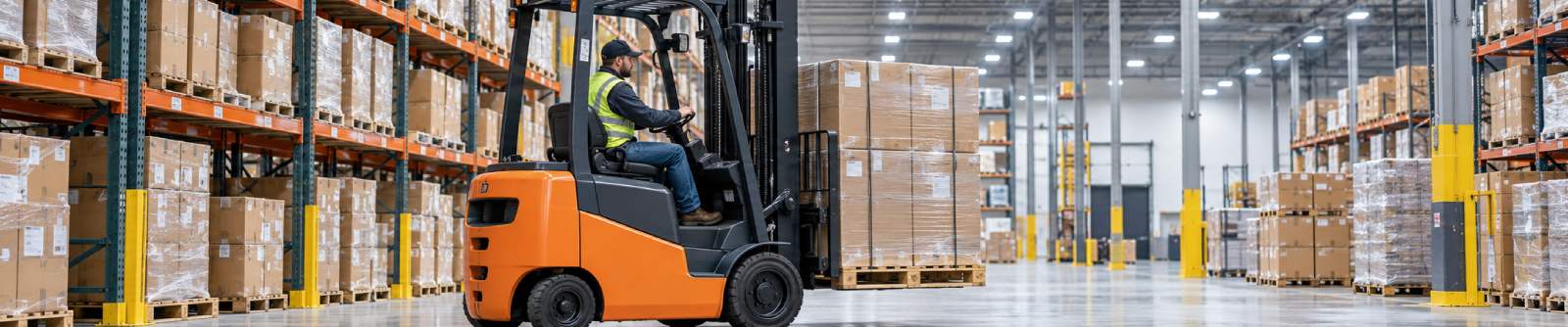
A counterbalance forklift uses a heavy rear counterweight to balance the load carried in front of its mast. Unlike most reach trucks, its normal front structure does not incorporate the same forward-extending load legs. This creates considerable versatility in approaching pallets, collecting loads on the floor, and loading or unloading trucks when the site conditions, clearances, and load ratings allow.
Counterbalance trucks are available with electric, diesel, and LPG powertrains in many markets. Tire design, ground clearance, truck classification, ventilation requirements, and operating environment matter as much as the power source. A diesel truck is not automatically right for every outdoor task, and an electric counterbalance model is not automatically limited to indoor operation. The manufacturer’s approved application and site assessment determine suitability.
Typical applications
Loading and unloading at suitable docks and staging areas. Transporting pallets between receiving, manufacturing, and dispatch zones. Handling a variety of loads within the truck's rated capacity and load center. Workflows involving longer travel and different warehouse zones. Mixed ground-level stacking and general material handling.
3. Reach truck vs. counterbalance forklift: side-by-side comparison
Main purpose
Reach Truck: High-rack pallet storage and retrieval
Counterbalance Forklift: General handling, loading, unloading, and transport
Stability concept
Reach Truck: Compact base, forward support legs, and model-specific balancing
Counterbalance Forklift: Rear counterweight offsets a forward load
Racking access
Reach Truck: Mast or fork carriage can reach forward
Counterbalance Forklift: Mast and forks are positioned by moving the truck
Stacking aisle
Reach Truck: Often narrower for comparable pallets
Counterbalance Forklift: Often wider for comparable operations
Lift height focus
Reach Truck: Built for high-bay applications
Counterbalance Forklift: Height varies considerably by model and mast
Surface requirements
Reach Truck: Usually smooth indoor floors for standard models
Counterbalance Forklift: Wider range of approved tires and surfaces
Power
Reach Truck: Predominantly electric
Counterbalance Forklift: Electric, diesel, or LPG, depending on model
Truck loading
Reach Truck: May be restricted or inappropriate for many dock tasks
Counterbalance Forklift: Common choice when site conditions permit
Space efficiency
Reach Truck: Can improve density with suitable rack design
Counterbalance Forklift: May require more maneuvering area
Key specification
Reach Truck: Aisle width, required lift height, residual capacity
Counterbalance Forklift: Load rating, load center, route, tires, environment
Important: These are typical differences, not universal rules. Compact three-wheel counterbalance trucks and specialized reach trucks can challenge simple comparisons. Always verify the actual technical datasheets.
4. Working aisle width: why clearances are about turning, not just fitting
Aisle width, often expressed as Ast in technical sheets, must allow the truck and its load to turn, align, and place a pallet safely. It is more than the chassis width. The answer varies with the pallet size and orientation, forks, load dimensions, battery compartment, turning geometry, and safe operational clearance.
As broad illustrations only, some reach truck applications use stacking aisles around 2.4–3.0 m, while some conventional counterbalance truck applications need approximately 3.6–4.3 m. These ranges are not design recommendations; specific models can fall outside them. The correct number must come from the manufacturer’s relevant Ast value, the actual pallets, and a site layout check.
A reduced stacking aisle may let a warehouse fit additional pallet rack positions in the same building. That potential storage gain must be calculated against safe pedestrian routes, emergency exits, sprinkler layout, fire safety, racking loads, and site traffic management—not solely from a brochure dimension.
5. Lift height and residual capacity: the most important technical check
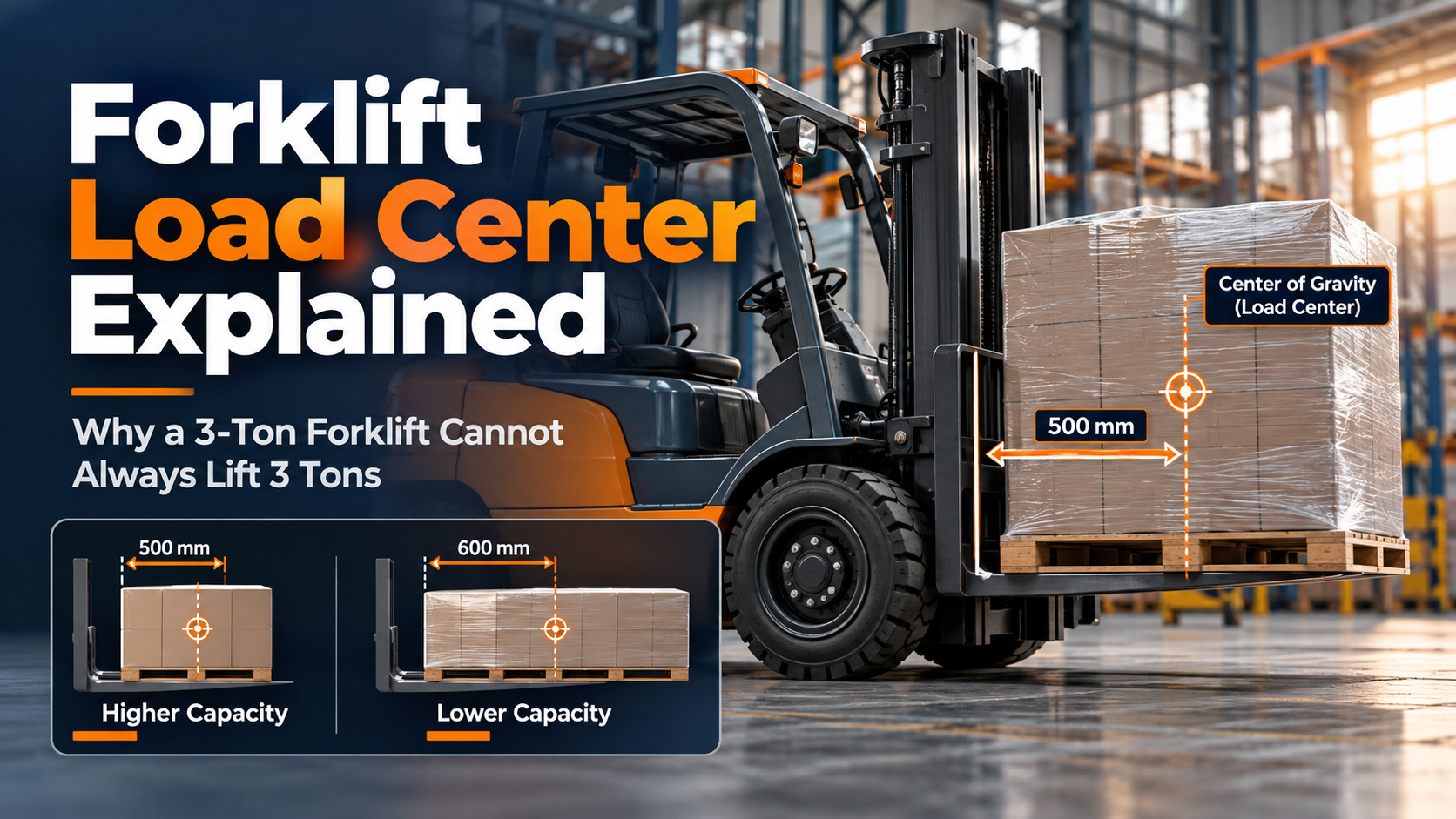
A common specification mistake is asking for a 2,000 kg forklift and assuming it can carry 2,000 kg to the maximum height printed on a mast brochure. Actual permissible capacity can decline with higher lift heights, a larger load center, extended reach, attachments, and mast configuration. The relevant measure is residual capacity at the required lift height.
The load center is the horizontal distance from the fork face to the load’s center of gravity. Nameplates may specify a rating at 500 or 600 mm, for example. A longer pallet or off-center load can change the actual moment and reduce safe carrying capacity.
Illustrative scenario, not an operating rating: A machine advertised as 2.0 t could be rated for a smaller load at 9 m. You cannot assume any particular capacity at 9 m without consulting the correct capacity diagram and nameplate for the actual truck, mast, attachments, and load center.
Modern reach trucks can offer substantial high-level performance. As an example of a model-specific configuration, STILL describes certain FM-X versions capable of handling up to 1,000 kg at 13 m. This is not a specification for all reach trucks, nor a substitute for checking the actual machine configuration.
6. Floor conditions, tires, and operating environment
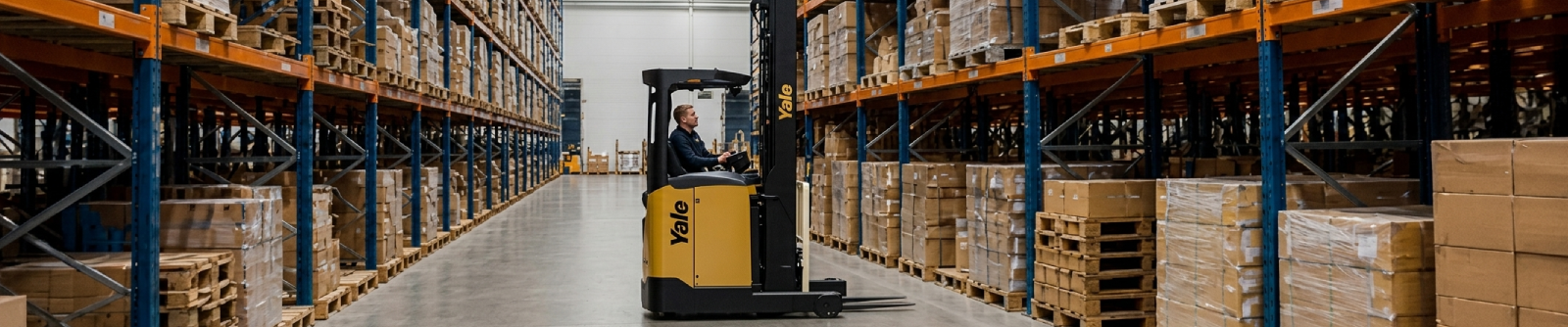
Reach trucks generally deliver their best precision on level, smooth indoor surfaces. Small load wheels and high-level stacking requirements make surface quality particularly important. Damaged floor joints, potholes, wet patches, and slopes can interfere with stability and precise handling. A standard indoor reach truck should not be used on a rough yard merely because it can physically move there.
Counterbalance forklifts offer a broader range of tire and application options, including solid and pneumatic tires on relevant models. This does not remove the need to assess floor loading with the truck plus payload, gradients, dock edges, turning spaces, door height, and the actual surface condition.
In Saudi Arabia, a robust selection process should also consider warehouse heat, sunlight exposure, dust, ventilation, sheltered or uncovered loading bays, and the approved operating temperatures of the battery and charger.
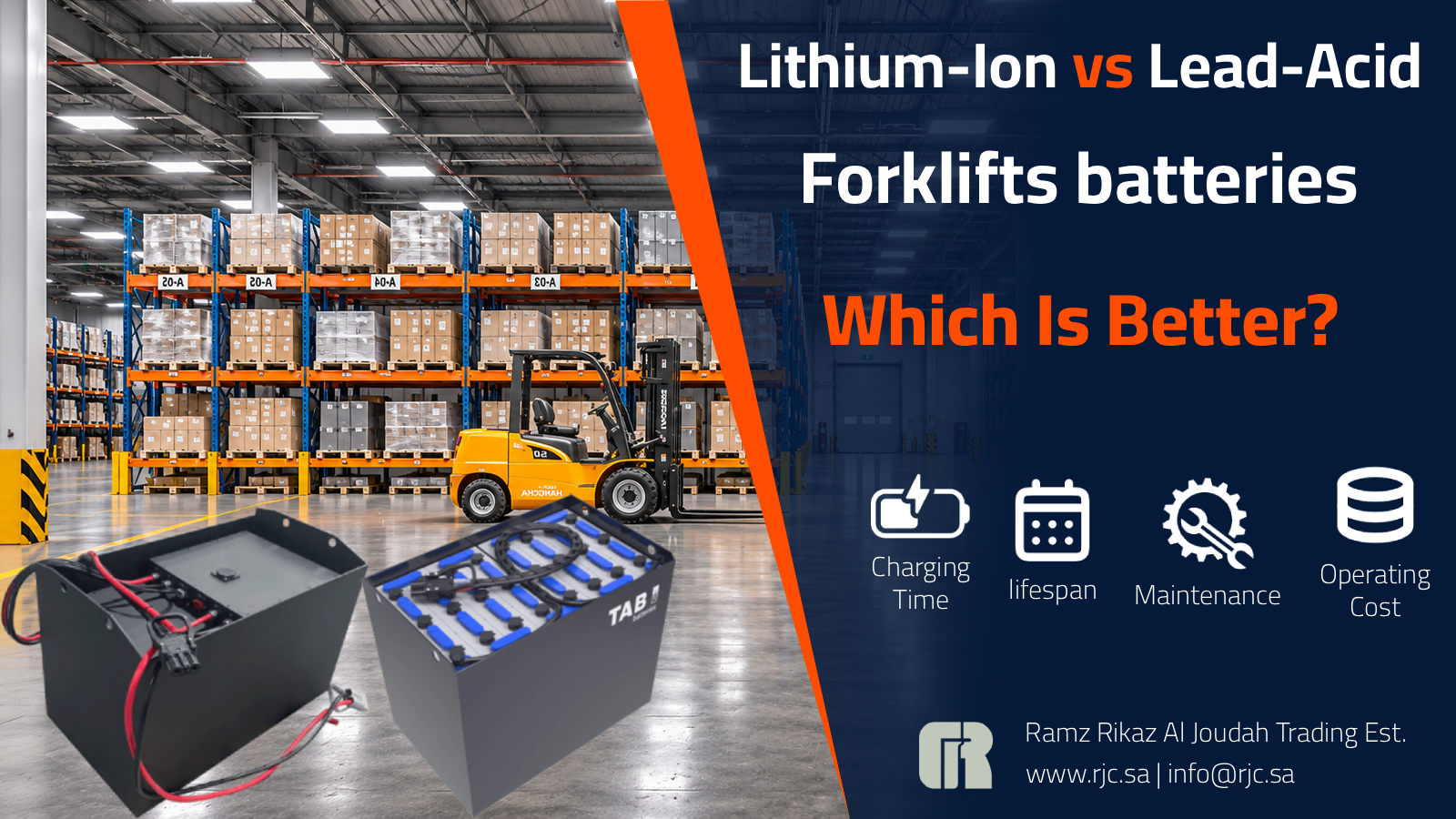
7. Electric power: lead-acid versus lithium-ion
Reach trucks are predominantly battery-powered, while counterbalance forklifts may be electric or combustion-powered. For electric equipment, the battery decision depends on shift length, lifting frequency, travel distance, permitted charging windows, available electrical infrastructure, and manufacturer-approved charging methods.
Lead-acid batteries: Depending on the offer, they may have a lower initial acquisition cost, but require appropriate charging procedures, service, and ventilation; heavy-duty use may necessitate battery changes or additional charging infrastructure.
Lithium-ion batteries: Depending on the system, they may support opportunity charging and reduce some routine battery service tasks. Total financial benefit still depends on battery and charger cost, thermal conditions, electricity supply, charging discipline, and usage intensity.
Only use approved batteries, chargers, and charging procedures. Generic charging rules do not apply to every battery chemistry or truck.
8. Productivity and total cost of ownership
The least expensive truck to acquire is not always the least expensive to operate. A proper total cost of ownership (TCO) comparison includes purchase or rental cost, maintenance, replacement parts, energy, downtime, operator efficiency, time per pallet move, and any storage-density benefits derived from redesigned aisles.
Where most tasks involve put-away and retrieval on high racks, a reach truck may save time and make more efficient use of space. Where much of the work involves unloading vehicles, moving freight across several areas, and handling mixed load types, a counterbalance forklift may avoid operational bottlenecks.
A useful test is to measure actual pallets handled per hour, average travel distance, time spent aligning forks at height, equipment downtime, charging windows, and peak demand. Compare the operating scenarios rather than making a decision based on rated capacity or rental rate alone.
9. Can a reach truck unload trailers?
A standard reach truck is designed mainly for warehouse racking, not as a universal substitute for a loading-dock forklift. Some specialist machines and locations may allow specific dock-related tasks, but the ability to enter a trailer or use a dock plate must never be assumed. Confirm the manufacturer’s rules, ramp and dock-plate ratings, trailer floor capacity, trailer restraint, clearance, and site assessment.
A frequent solution is to separate the work: use a counterbalance forklift for receiving and dispatch, and a reach truck for high-bay storage. Whether this arrangement is economical depends on throughput and the building’s layout.
10. Reach truck types: single-deep, double-deep, and moving-mast
Single-deep reach trucks are generally matched to racks with one pallet position in depth. Each accessible rack face can be served directly.
Double-deep reach trucks use an extended reach mechanism for pallets stored two positions deep. They can increase density but may restrict direct access to the rear pallet and require compatible racking and inventory sequencing. Not every reach truck has this function.
Moving-mast reach trucks move the mast assembly forward and back. Pantograph reach trucks extend the fork carriage through an articulated mechanism. The suitable design depends on racking, lift height, reach distance, and the manufacturer’s specifications.
Very narrow aisle (VNA) and turret trucks are a separate specialist category; they should not be treated as ordinary reach trucks.
11. Seven mistakes to avoid when selecting equipment
- Comparing nominal capacity only instead of rated residual capacity at the highest rack level.
- Measuring the clear aisle but ignoring stacking maneuver space, pallet orientation, and obstacles.
- Ignoring pallet and packaging weight, actual load dimensions, and uneven weight distribution.
- Overlooking lowered mast height beneath doors, beams, or other overhead obstructions.
- Assuming any forklift can work outdoors regardless of tires, gradient, and approval.
- Failing to account for attachments such as side shifts or fork positioners when verifying capacity.
- Neglecting site safety, including trained operators, inspections, pedestrians, traffic routes, and racking protection.
12. Three typical warehouse scenarios
Scenario A: High-rack distribution center with narrow aisles
A distribution center uses tall pallet racks and wants higher storage density. First option to evaluate: a reach truck, subject to confirmation of residual capacity, aisle geometry, floor conditions, available vertical clearance, and the actual rack design.
Scenario B: Warehouse with an outdoor loading bay
Daily trucks arrive at a loading area, and pallets move between the dock, a yard, and the building. First option to evaluate: an appropriately specified counterbalance forklift. A separate reach truck may still be worthwhile for high-rack storage indoors.
Scenario C: Manufacturing site with variable loads
A site handles crates, oversized materials, and pallets of varying shape. A counterbalance forklift may offer better task flexibility, but load center, approved attachments, and actual center of gravity must be checked carefully. A high-rack operation with standard pallets may still warrant a dedicated reach truck.
13. Information to prepare before requesting a quotation
Provide the equipment supplier with the following information:
Information Required for Equipment Selection
14. Frequently asked questions
Is a reach truck a forklift?
Yes. It is a specialized category of electric forklift, primarily designed for high-rack storage in narrow warehouse aisles.
Does a reach truck always lift higher than a counterbalance forklift?
No. Reach trucks are often specialized for high-rack work, but available heights vary by model. Compare the required height and residual capacity for each exact configuration.
Can a reach truck operate outdoors?
Most standard models are optimized for indoor floors. Some specialist models have indoor/outdoor capabilities. Always follow the manufacturer’s approved conditions.
Which works in narrower aisles?
A reach truck is often better suited to narrow rack aisles. The exact answer depends on manufacturer Ast figures, pallet orientation, and clearances. Very narrow aisle applications may require specialist VNA trucks.
Can both types be used together?
Yes. Dividing dock-handling and high-rack operations between different truck types can improve throughput if the site has enough work to justify it.
Do fork positioners or side shifts affect lifting capacity?
They can. Attachments must be approved for the truck, and the applicable capacity information must reflect the specific setup.
What is the key technical number for a reach truck?
There is no single sufficient number. Start with residual capacity at the highest required lift height, plus stacking aisle width and the actual load geometry.
Conclusion: which forklift should you choose?
Start with a reach truck when high-density, high-rack storage and narrow-aisle pallet handling are your core requirements. Start with a counterbalance forklift when loading, unloading, mixed-load transport, or multiple operating zones dominate the workload. For some facilities, combining both provides the best balance of storage density and handling flexibility.
Planning a Forklift Purchase or Rental in Saudi Arabia?
Contact Ramz Rikaz Al Joudah Trading Est. and share your warehouse location, pallet weight and dimensions, highest storage level, aisle width, and daily operating hours. Our team can review suitable equipment configurations before preparing a quotation.
Comments (0)